
Chase 5/24 Rule
One of the first questions new points & miles enthusiasts often have is, why is everyone talking about Chase? Another popular question is, are Chase points (Ultimate Rewards or URs) that much more valuable than all other points & miles? These questions are understandable, and the answers to these questions are foundation setting principles that everyone learns when just starting out. A big reason Chase is on the forefront of everyone's mind, at least when they first get into miles and points, is the Chase 5/24 rule. Just what is the Chase 5/24 rule & why is it so important? We will dive into all of that in our Chase 5/24 guide here.
Chase Credit Card Application Rules
While the Chase 5/24 rule is one of the most important, it isn't the only rule they have. Chase, like every bank, has lots of rules for credit card applications. Here are the other Chase application rules that you should be aware of outside of the Chase 5/24 rule:
The “2/30” Rule
This application rule means that you will not be approved for more than 2 Chase cards in a 30-day period.
The 0/30 Rule
This Chase application rule means that you can not have applied for any Chase credit cards in a 30-day period before applying for a business card.
The Sapphire Family Rule
This rule deals with the Sapphire family of cards (Sapphire Preferred, Sapphire Reserve and plain Sapphire card – only available via downgrade). Chase changed their rules in late 2025, allowing you to now apply for either card at any time (subject to the other rules in this article). As the rules were updated, now you may not be eligible for a sign up bonus on a Sapphire card if you have held that Sapphire card in the past. The good news is that you can now get the Sapphire Preferred while holding the Sapphire Reserve and vice versa, meaning you can earn the sign up bonus for both cards.
Historically, the Sapphire family rule meant that you could only receive one welcome offer every 48 months from any of the three Chase Sapphire cards. It also meant that you cannot apply for a new Sapphire product while currently carrying one of the three cards. You could carry more than one Sapphire product, via upgrades and downgrades, outside of approvals though.
The Ink Family Rule
There are new terms for the Chase Ink Cash and Chase Ink Unlimited cards. Essentially, Chase has shared that the signup bonus may not be available to you if you have held the card you are applying for or another no annual fee Chase business card. Further, if you have held the Chase Ink Business Preferred, you may not be eligible for the sign up bonus. The same goes for the Chase Sapphire Reserve for Business. Don't forget that in order to apply for one of these business cards, the Chase 5/24 rules still apply.
The Southwest Family Rule
The Southwest family of cards have their own set of rules. The good news is that it only deals with the personal Southwest credit cards. This means that you cannot get a new Southwest personal card offer, from any of their 3 cards, within 24 months of earning the sign up bonus. It also means that you can not sign up for a new Southwest personal card while currently holding another Southwest personal card. The business cards do not have this family rule.

The Chase 5/24 Rule Explained
Quite simply, the Chase 5/24 Rule is a count of how many personal credit card accounts you've opened in the prior 24 months from any bank. While most business cards don't count towards this, some do. The short version is that these business cards will count against your Chase 5/24 count:
- TD Bank
- Discover
- Some Capital One business card
- For a full breakdown of this check our full Chase 5/24 rule business card guide.
It should also be reiterated that your 5/24 count is based on personal cards that you have actually opened and not based on hard pulls. Some other banks focus solely on hard pulls, while Chase focuses on approvals.
You will be automatically denied for Chase applications if your count of new personal credit cards (and a few business cards) is at five or more in the last 24 months. This is why it is imperative to understand the Chase 5/24 rule and to focus on it early in your miles & points journey.
What About Chase Business Cards? How Do They Play Into The Chase 5/24 Rule?
It should also be noted that while Chase business cards do not add to your 5/24 count, you do need to be below 5/24 to be approved for them. This is something that often trips people up when they are first learning about the Chase 5/24 rule.
Exceptions To This Infamous Rule
There are three very rare exceptions to the Chase 5/24 rule. Those are as follows:
- Some very high net worth Chase Private Client banking customers are able to be approved while above 5/24 with the help of a banker.
- In rare occasions a person can be targeted for an offer in their Chase account that works outside of the Chase 5/24 rule.
- Sometimes Chase let's people through on offers without rhyme or reason. These are 1 in 1,000 or more type cases.
Outside of these very rare instances, you will need to wait until your 5/24 number falls below 5 personal credit card approvals, across all banks, over the past 24 months to be approved.
How Do You Determine Your 5/24 Status?
The easiest way to determine your current Chase 5/24 status (for free) is to download Credit Karma and/or Credit Sesame. You should ignore their credit score models, as they are notoriously inconsistent and attempt to draw you back to their apps with wild fluctuations in your score.
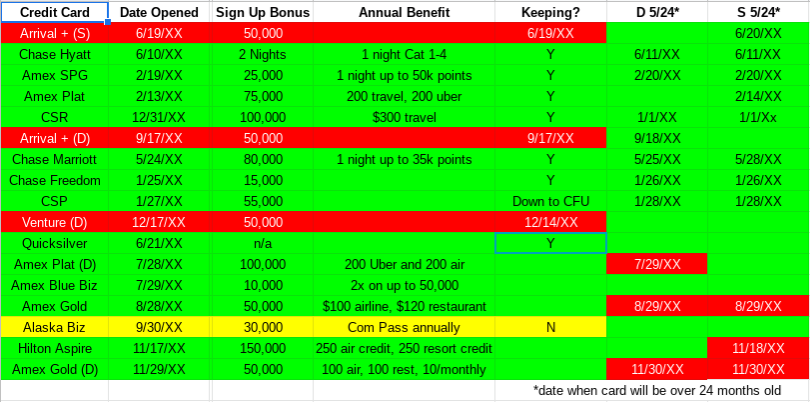
Both apps are great for looking at all the accounts on your credit report and confirming the date each account was opened. It is important to note that if a business card does not report to your personal credit report, it will not show up on Credit Karma or Credit Sesame. Before you begin your award travel journey and navigating the Chase 5/24 rule, you must confirm your 5/24 status. Once known, I highly recommend creating a spreadsheet to track your Chase 5/24 status. This spreadsheet can also track your annual fee due dates, sign-up bonus, opening/closing dates, etc. Here is a look at a sample chart that is similar to ours:
Your Plan Of Attack If Just Starting Out & Under The Chase 5/24 Rule
If you're just learning about rewards travel, and you are under 5/24, congratulations! You are now eligible for Chase credit cards under the Chase 5/24 rule. Here is how you should consider getting started on this path.
Chase Sapphire Preferred vs Chase Sapphire Reserve
The first step in the journey is obtaining a Ultimate Rewards earning card. That means you will have to decide between a Chase Sapphire Preferred card and a Chase Sapphire Reserve card. We have a guide breaking down the differences between those two day one cards that you should read. The good news, as mentioned above, is you can now start with one and get the other one a little later in your journey.
Remember, if you grabbed one of these previously in your journey, just remember that you will likely only receive a bonus for the card you haven't held before.
Figuring Out If You Are Eligible For Ink Business Cards
Once you have a Sapphire Preferred or Reserve in your tool belt, your next step is to look at getting one of the Chase Business cards. These are some of the most rewarding cards on the market for your business spend. The points also pair perfectly with the ones earn from your Sapphire card. You can pool all of your Ultimate Rewards together across both types of cards. The Sapphire products even unlock the no fee business card earnings and make them a fully transferrable currency. Pretty cool, huh?
Chase offers the following Ultimate Rewards earning business cards (click the links for our full card reviews):
- Ink Business Cash
- Ink Business Unlimited
- Chase Ink Business Preferred
- Chase Sapphire Reserve for Business
You may be wondering if you are even eligible for business cards. Many people are and just don't realize it. We discuss that in more detail here. If you are eligible, carrying a few different business cards can really increase your earning ability.

Freedom Flex
Once you have your Sapphire product and have gotten a Chase Business card, which don't add to your Chase 5/24 count, it is time to take a look at Freedom Flex card. This card is a great long term earner for Ultimate Rewards points. It offers up 5x rotating categories each quarter that can amount to 30,000 easy Ultimate Rewards each and every year. These are fully transferrable points since you should already have that Sapphire product to unlock them fully.
Chase also has a Freedom Unlimited card, but most would be better off with the Freedom Flex card. That is especially true if you grabbed the Ink Business Unlimited previously (or plan to), since the earning overlaps quite a bit.
Move Towards Co-Branded Cards
After you have your Sapphire(s), Ink(s), CSRB, and Freedom cards, it is time to take a look at the co-branded cards Chase has to offer. These are the cards that you focus on right before going over 5/24. While it is extremely important to understand the Chase 5/24 rule, the intent is not to stay under 5/24 forever, after all. The goal is to get the cards you want and then move on.
When you get to this portion of your journey it is best to focus on which co-branded cards work best for your needs. This will be based on which ones give you perks that you can use, as well as which brands match up with your travels best. You want to choose cards that will be long term keepers for you, since you may not be able to come back around to them for a while once you go over 5/24. There are also a few co-branded business cards offered by Chase that will not count against your 5/24 count, just like the Ink cards and the Chase Sapphire Reserve for Business.
Chase 5/24 Rule: Chase Co-Branded Business Cards (in no particular order)
- World of Hyatt Business
- United Business
- Southwest Performance Business
- Southwest Premier Business
- IHG Premier Business
Chase 5/24 Rule: Chase Co-Branded Personal Cards (in no particular order)
- World of Hyatt Personal
- Aeroplan Mastercard
- British / Iberia / Aer Lingus
- IHG Premier
- IHG Traveler
- Southwest Plus
- Southwest Priority
- Chase Southwest Premier
- United Quest
- United Explorer
- Chase United Gateway
- United Club Infinite
- Marriott Bonvoy Bold
- Marriott Bonvoy Boundless
- Chase Marriott Bonvoy Bountiful
Your Plan Of Attack If You're Over The Chase 5/24 Rule
If you're new to award travel, only to realize that you are over 5/24 (whomp, whomp, whomp!), do not fret. There are TONS of great options out there. Chase is the only bank that unofficially-officially recognizes the 5/24 rule. After all, that is why we call it the Chase 5/24 rule. Other banks do not apply this rule, but have some of their own.
You can still grab many rewarding credit cards, then eventually get back under 5/24 to open those valuable Chase cards. Your journey will just be different than most others'. Pay attention to our full 5/24 business card guide to give you access to some amazing cards while you await your drop back under 5/24.
Chase 5/24 Rule Explained: ToP Thoughts
Hopefully after reading all about the Chase 5/24 rule, you now know what the Chase 5/24 rule is, why it is important, and how to navigate it going forward. You should now have a road map to follow whether you are currently over or under, Chase 5/24.
If you still are having trouble understanding this rule please do not hesitate to reach out to us via email on the Contact Us page or in our Facebook group for a personalized plan moving forward.
Good luck to all as you begin your award travel journey!